Scotland’s Dog Suicide Bridge: The Mystery Nobody’s Solved

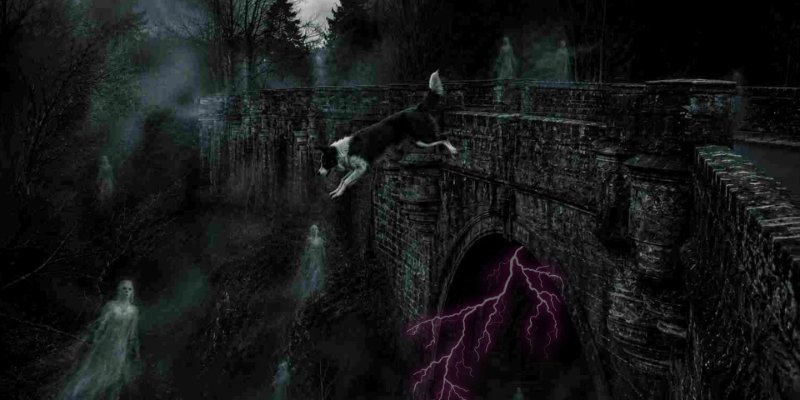
There is a stone bridge outside Dumbarton, Scotland, that dog walkers have learned to cross with a lead in hand and a knot in their stomach. Locals call it the dog suicide bridge, a nickname that has stuck for seventy years precisely because the dog suicide bridge keeps producing new cases instead of fading into old rumor. Since the 1950s, something has been pulling healthy, happy family dogs over its parapet, some to their deaths on the rocks fifty feet below, others to broken bones and a strange, lasting fixation on the exact same spot. Why do dogs jump off Overtoun Bridge is a question that has drawn RSPB scientists, canine behaviourists, and more than one working psychic, and none of them have fully closed the case.
Overtoun Bridge was never supposed to be famous for this, or for the White Lady of Overtoun who supposedly haunts it. It was built in 1895 as a quiet driveway extension for a Victorian country house. Nearly seventy years later, it became one of Scotland’s most persistent unsolved animal mysteries, and one that sits right at the intersection of hard science and old-fashioned dread.
How a Victorian Carriage Bridge Became Scotland’s Dog Suicide Bridge
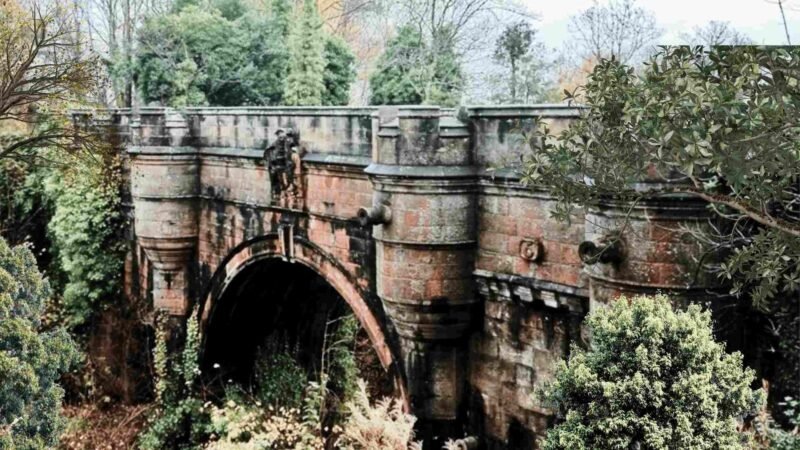
Overtoun Bridge near Dumbarton, Scotland, the sandstone arch behind the decades-long dog suicide bridge mystery.
A Driveway Bridge for a Victorian Estate
Overtoun House was bought by the industrialist James White in 1859. When he died in 1884, his son, John Campbell White, later Lord Overtoun, inherited the estate in West Dunbartonshire and commissioned a bridge across the steep gorge known as Spardie Linn so carriages could reach the house more easily. Landscape architect Henry Milner designed it, and the rough sandstone structure was finished in June 1895, decades before anyone had a reason to call it Overtoun Bridge Scotland’s strangest landmark.
When the Jumps Began
For sixty years, it was just a bridge. Then, starting in the 1950s, dog walkers began reporting something nobody had a name for: a dog freezing mid-stride at the same stretch of parapet, then bolting and going straight over the wall. Estimates of the total number of jumps vary wildly, from roughly 300 in more careful tallies to 600 in the more sensational retellings, but most sources converge on around 50 confirmed deaths, with the rest of the dogs surviving the fall onto rock and shallow water below.
The White Lady Who Supposedly Won’t Leave
A Grieving Widow’s Legend
Long before any dog went over that wall, Overtoun already had a ghost story. The legend of the White Lady of Overtoun holds that a grieving widow from the estate, generally identified with Lord Overtoun’s own wife, never left the grounds after her husband’s death and still walks them today, dressed in white. Different retellings put her death anywhere from the early 1900s to the 1930s, and some give her a different name entirely, which is itself a clue that this is folklore being passed hand to hand rather than a fixed historical record. Residents have described seeing a pale figure in the windows of Overtoun House or feeling a presence near the bridge itself.
A Story Older Than the Dog Jumps
White Lady legends are not unique to Scotland. They turn up across Europe and beyond, almost always tied to grief, betrayal, or a death that was never properly mourned. What makes the White Lady of Overtoun stick is timing: once dogs started jumping in the 1950s, a decades-old ghost story and a brand-new animal mystery quietly merged into one narrative, even though nothing ties them together except geography.
Overtoun as a Celtic “Thin Place”
Celtic folklore has another, older frame for places like this. It calls them “thin places,” spots where the boundary between the physical world and whatever lies beyond it is said to wear unusually thin. One psychic who walked her own Labrador across the bridge reported no dread at all, only what she described as calmness, though she admitted her dog pulled hard toward the same right-hand side where the jumps cluster. Overtoun’s steep gorge, its Victorian gothic house, and its long recorded history of strange animal behavior make it an easy fit for the thin-place label, whether or not you believe a word of it.
The 1994 Tragedy That Gets Wrongly Folded Into the Legend

Overtoun House near Dumbarton, Scotland, the Victorian mansion whose grounds are home to the dog suicide bridge and the White Lady of Overtoun legend.
Overtoun’s darkest chapter has nothing to do with dogs at all, and nothing to do with the White Lady of Overtoun either. In October 1994, a father suffering from acute psychiatric illness threw his two-week-old son from the bridge during a delusional episode, believing the infant was connected to a malevolent force. The child died the next day. A jury later found the father not guilty by reason of insanity, and he was detained at a psychiatric hospital. Some retellings blend this tragedy into the cursed-bridge story as if it proves the site is malevolent. It doesn’t. One is a documented, tragic case of severe mental illness. The other is an unresolved pattern in animal behavior. Treating them as the same story does a disservice to both.
What Investigators Actually Found When They Looked Underneath
The RSPB’s Mink Scent Test
Two separate investigations tried to get past the folklore surrounding Scotland’s dog suicide bridge and answer the mystery with something more testable than a legend. Animal habitat expert David Sexton, working on behalf of the RSPB, first ruled out sound: an acoustics firm from Glasgow tested whether the nearby Faslane naval base, home to the UK’s Trident submarines, was emitting some frequency only dogs could hear, and found nothing unusual. Sexton then searched the vegetation along the stretch of parapet where jumps clustered and found nests belonging to mice, squirrels, and American mink. When he presented ten dogs from breeds that had previously jumped with canisters of each scent, seven went straight for the mink sample, several of them dramatically, giving the mink scent theory its strongest piece of physical evidence.
David Sands and the Hendrix Case
Canine behaviourist David Sands ran a parallel investigation with the Scottish SPCA. In 2006, he brought Hendrix, at that time the only dog on record to have survived a jump, back to the same stretch of bridge. Age had taken away Hendrix’s ability to climb the parapet, but not his fixation with that exact spot. Sands also strapped a camera to his own dog and walked it across the bridge to study its behaviour at ground level, and later told the Science Channel that the phenomenon likely comes down to a unique combination of wildlife, structure, and foot traffic specific to this one bridge.
Why Long-Nosed Breeds Are Most at Risk
Almost every dog that has gone over the wall has been a long-nosed breed: collies, retrievers, spaniels, Labradors, the kind bred for generations to track scent over long distances. Short-nosed breeds are almost entirely absent from the incident reports. UK behaviourist Stan Rawlinson has also pointed to dogs’ comparatively weak depth perception as a contributing factor, since a drop that would clearly register as a threat to a person may not register the same way from a dog’s eye level, especially with a solid wall blocking the view until the animal is already on top of it.
The Local Who Says the Whole Theory Is Wrong
John Joyce’s Objection
Not everyone buys the mink scent theory, including someone who arguably knows the land better than any visiting researcher, a point David Sands has acknowledged as fair pushback in his own writeups. John Joyce, a hunter who has worked the ground around Overtoun for roughly fifty years, has stated flatly that there is no mink in the area for dogs to be drawn to. It’s a real, on-record objection, not a supernatural one, and a fair account of this mystery has to include it rather than smooth it over. Sexton’s investigation did physically locate nests and burrows in the rock crevices below the favoured stretch of parapet, so both things can plausibly be true at once: mink may be far less visible to someone scanning the land from a distance than to a researcher searching crevices at close range. John Joyce’s skepticism means the Overtoun Bridge mink theory remains the strongest available explanation, not a closed case.
An Inconclusive Second Opinion
The Scottish SPCA ran its own separate inquiry and came back inconclusive, which is part of why this mystery has never been formally closed even as the scent theory has become the dominant one.
So Can Dogs Actually Sense Something We Can’t?
Set Overtoun aside for a moment. The broader question of whether dogs perceive things beyond ordinary explanation comes up constantly in paranormal circles, and it’s worth being straight about where the evidence actually sits. There is no controlled scientific study showing dogs can detect ghosts or spirits. What is well documented is that dogs experience the world through senses that dwarf ours: an estimated 300 million olfactory receptors compared with roughly six million in humans, a dedicated organ for reading chemical signals, and hearing that stretches well above the range people can perceive. Researchers who study animal cognition, including Barnard College’s Alexandra Horowitz, have pointed out that behaviour people read as sensing a spirit is very often a dog registering a sound, scent, or subtle environmental change that a person in the same room simply cannot pick up on.
That doesn’t make the eerie stories less eerie. It does mean that at Scotland’s dog suicide bridge, and at plenty of other reportedly haunted locations, the most honest explanation usually starts with biology rather than the supernatural, even when biology alone hasn’t tied off every loose thread.
Named Cases That Made the Dog Suicide Bridge Infamous
2004 to 2005: The Cases That Started the Pattern
The pattern didn’t cluster in one unusual year. In 2004, Kenneth Meikle was walking his family’s Golden Retriever across the bridge when the dog suddenly bolted for the parapet and jumped; it survived but was visibly shaken. At least five more dogs jumped within a six-month span the following year.
2011 to 2019: Sophie, Cassie, and Bonnie
In 2011, Sophie, a Labrador belonging to David and Louise McPhail, went over the same stretch of wall in what Louise later described as a matter of seconds. In 2014, Alice Trevorrow’s Springer Spaniel, Cassie, did the same, staring at something above the bridge moments before she jumped. And in what The New York Times reported as roughly three years before its 2019 coverage, Lottie MacKinnon’s border collie, Bonnie, froze on the first step onto the bridge before suddenly bolting and going over, surviving the fall.
Is It Still Dangerous Today?
Precautions That Actually Work
Reported incidents at the dog suicide bridge have dropped noticeably since the 2010s, partly because awareness of the pattern has made owners more careful on that specific stretch of parapet. Following the Sands investigation, signage went up at both ends of Overtoun Bridge warning dog owners about it, and it hasn’t stopped visitors from asking staff about the White Lady of Overtoun in the same breath. The most practical precaution, regardless of which theory you find most convincing, is a simple one: keep dogs on a lead while crossing, especially on clear, dry days, when scent is thought to carry furthest.
Visiting Overtoun House Today
Overtoun House and its grounds remain open to the public and are a popular walking route to this day. The current owners have spoken to press about the bridge’s reputation, and about living beside a landmark that keeps generating both scientific inquiry and ghost stories in equal measure.
An Unsolved Case, By Design
What makes Overtoun genuinely interesting, for anyone who follows strange phenomena rather than just skimming the headline, is that it refuses to resolve cleanly into either camp. It isn’t a hoax dressed up as a haunting, since real dogs have really died there for seventy years. It also isn’t proof that the White Lady of Overtoun or anything else supernatural is at work, since the strongest available explanation is grounded in verifiable field research, not folklore. The mink scent theory explains the breed pattern and the weather pattern well. It does not explain why other bridges near mink habitat elsewhere in Scotland haven’t produced the same phenomenon, and no controlled study has ever compared Overtoun directly against a matched set of similar sites. Until someone runs that comparison, the honest answer to why do dogs jump off Overtoun Bridge is: probably scent, almost certainly not a ghost, and not entirely settled either way.
For a full breakdown of the RSPB’s scent trial, the named investigators, and every documented case on record, StrangeHappen.com has put together a deeper investigation of why dogs jump off Overtoun Bridge, including the skeptic’s case against the mink theory and what current safety signage at the bridge actually says.
These are the questions people ask most about Scotland’s dog suicide bridge and the White Lady of Overtoun.
Frequently Asked Questions About Overtoun Bridge
Why do dogs jump off Overtoun Bridge?
The best-supported explanation is scent. An RSPB investigation led by David Sexton found mink, mouse, and squirrel nests beneath the bridge’s favoured parapet, and seven of ten tested dogs were drawn straight to the mink sample. A solid wall that hides the drop until a dog is already on top of it is thought to make the pull more dangerous.
Is Overtoun Bridge haunted?
There’s no physical evidence behind the White Lady of Overtoun or other ghost theories. The legend predates the dog jumps by decades and persists mainly as local folklore, while the RSPB’s tested explanations, scent and sound, remain the only theories backed by fieldwork.
How many dogs have died at Overtoun Bridge?
Estimates vary, with some researchers citing roughly 300 total jumps and others closer to 600, but most sources converge on about 50 confirmed deaths since the 1950s, with the remainder surviving the fall.
What is the mink scent theory at Overtoun Bridge?
It holds that dogs are pulled over the parapet by the strong scent of American mink nesting in the rocks below, a theory built on David Sexton’s discovery of mink nests and a scent test in which most dogs were drawn overwhelmingly to the mink sample.
Do dogs still jump off Overtoun Bridge?
Reported incidents have dropped since the 2010s, largely due to warning signage and more cautious dog owners, though isolated jumps are still occasionally reported.
Who is the White Lady of Overtoun?
She’s a local legend, usually identified as the grieving widow of Lord Overtoun, said to haunt the estate after his death. Accounts of her name and timeline vary by source, marking her as folklore rather than a documented historical figure.
Was the 1994 Overtoun Bridge tragedy connected to the dog jumps?
No. That incident was a documented case of a father suffering acute psychiatric illness who threw his infant son from the bridge. It is a separate tragedy from the animal-behavior mystery and shouldn’t be blended into it.
What breed of dogs jump off Overtoun Bridge most often?
Almost every recorded case involves a long-nosed breed such as a collie, retriever, spaniel, or Labrador, breeds developed for scent-tracking, which supports the mink theory over sight- or sound-based explanations.
Guest Author Bio
This article was written by Mubashir Razzaq. Mubashir writes about strange phenomena, unexplained history, and the science behind them at StrangeHappen.com, where he covers everything from unsolved animal-behavior mysteries to ancient civilizations. His approach favors named investigators, primary sources, and documented cases over secondhand retellings, which is also where you’ll find his full investigation into why dogs jump off Overtoun Bridge.
Enjoy Paranormal Globe?
Add us as a Preferred Source on Google to see more latest stories in Google Search.
About the Author: Guest Post