Meet SIGNAL: Can an AI Assistant Make Paranormal Investigations More Accountable?

By Andrew Underwood, Founder & Lead Researcher, VEIL Research Project
What if the next major advancement in paranormal investigation wasn’t another device designed to detect a ghost, but an artificial intelligence designed to question the evidence?
That question is helping shape one of the most ambitious developments within the VEIL Research Project.
We’re calling it SIGNAL.
SIGNAL is an artificial intelligence research assistant being developed to help document, organize, evaluate, and eventually coordinate experiments involving unexplained environmental phenomena.
But SIGNAL isn’t being created to tell investigators what they want to hear. Quite the opposite.
Its purpose is to help us ask better questions, recognize ordinary explanations, and identify exactly what our instruments have — and haven’t — recorded.
The Problem With Paranormal Evidence
Spend enough time exploring paranormal investigations online and you’ll encounter thousands of photographs, audio recordings, and videos described as evidence of something extraordinary.
Some are fascinating. Others have relatively straightforward explanations.
The challenge is determining which is which.
A photograph may contain an unusual shape, but what were the lighting conditions? Was there movement? Could it have been a reflection, an insect, or an image-processing artifact?
An audio recording may contain what sounds like a voice, but could the source have been distant conversation, electronic interference, or our natural tendency to recognize familiar patterns in ambiguous sounds?
These aren’t questions intended to dismiss someone’s experience.
They’re questions that deserve answers.
At VEIL, we believe the unexplained should remain unexplained until sufficient evidence supports a more specific conclusion.
And that is where SIGNAL enters the picture.
Meet SIGNAL
SIGNAL began with a deceptively simple idea.
What if an investigator had an assistant capable of remembering experimental procedures, reviewing collected data, comparing observations across instruments, and asking questions that a human researcher might overlook?
Imagine an experiment in which a microphone records an unexplained sound.
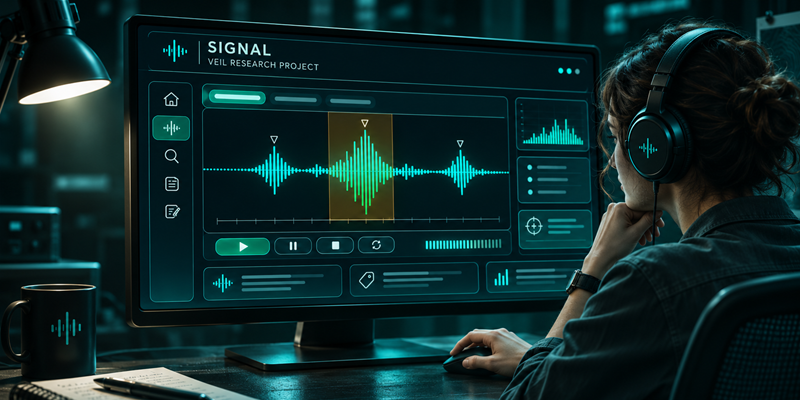
Rather than immediately labeling it an electronic voice phenomenon, SIGNAL could eventually compare that recording with synchronized video, environmental sensors, equipment activity, and earlier recordings.
Was someone speaking nearby? Did an electrical device activate? Did another microphone capture the same sound? Was the recording made during an established control period?
SIGNAL’s role would be to organize these observations and help investigators evaluate possible explanations.
Not to declare that a spirit had spoken.
That distinction is fundamental to our approach.
From Concept to Working Prototype
SIGNAL is not yet a finished system.
Our current development includes a functioning local AI foundation using Ollama, preliminary conversational capabilities, and early voice-interface components. We’re working toward integrating those pieces with
VEIL’s research records and experimental equipment.
The objective is to make SIGNAL increasingly capable of operating locally, without depending entirely on remote commercial AI services.
Why is that important?
Because research equipment may eventually need to function in remote locations with unreliable internet access. Local processing also provides opportunities to maintain greater control over experimental records and sensitive information.
Our long-term plans go considerably further than the current prototype.
We envision SIGNAL communicating with cameras, microphones, temperature arrays, electromagnetic sensors, and other instruments while assisting researchers through a conversational interface.
Those capabilities remain development goals, not established achievements.
We’re approaching the project one tested component at a time.
Bringing SIGNAL Into the Laboratory
One of our first research instruments is the Mobile Trans-Communication Device, or MTC.
The MTC is designed to conduct unattended audio experiments using prerecorded questions, controlled observation periods, and continuous recording.
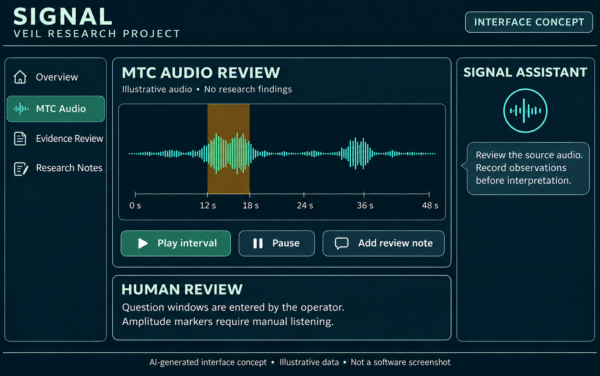
Interface concept illustrating audio-interval review and human observation notes. AI-generated mockup with illustrative data; not a screenshot of operational software. Image: VEIL Research Project.
Its purpose isn’t simply to capture mysterious voices.
It’s to investigate whether unusual audio events occur under repeatable conditions, particularly when human observers are absent.
We have already conducted preliminary unattended recording tests, although much more validation will be needed before drawing conclusions about any anomalous observations.
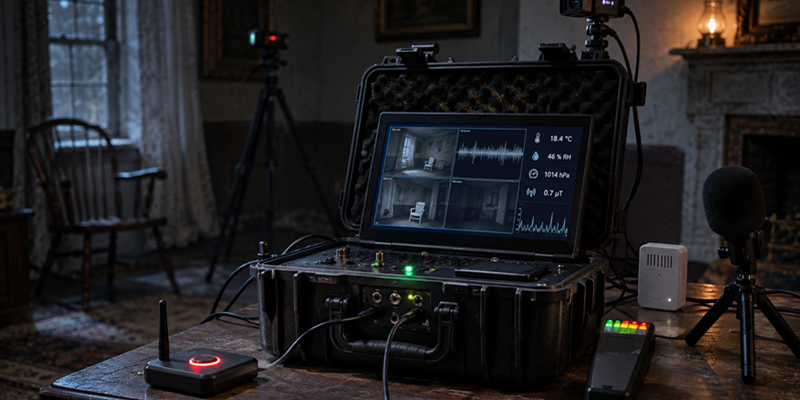
Another VEIL concept is the Panic Box, a proposed multi-sensor system intended to preserve evidence when an unusual event is reported.
Instead of relying entirely on someone remembering what happened, the system is intended to preserve synchronized recordings and measurements from before, during, and after an event.
Eventually, SIGNAL could help connect observations from these instruments.
For example, if a temperature sensor records a sudden change while an unusual sound occurs, SIGNAL could flag the coincidence for examination.
But two events happening at the same time do not automatically establish a causal relationship.
That would be another question for investigators to study.
Why Human Oversight Matters
Artificial intelligence has remarkable capabilities, but it also has limitations.
AI systems can make mistakes, generate inaccurate explanations, and identify patterns that have little or no real significance.
In paranormal research, where expectation and interpretation already create considerable challenges, those limitations matter enormously.
An AI assistant trained or prompted to find ghosts everywhere might become very good at producing ghost-related explanations.
That wouldn’t make the explanations correct.
SIGNAL is therefore being designed around an essential principle:
The human researcher makes the final determination.
AI can assist with comparing data, recognizing inconsistencies, organizing records, and suggesting further tests.
It should not manufacture certainty where certainty doesn’t exist.
We also want every potential anomaly to remain connected to its original recording, equipment source, timestamp, experimental conditions, and documented analysis.
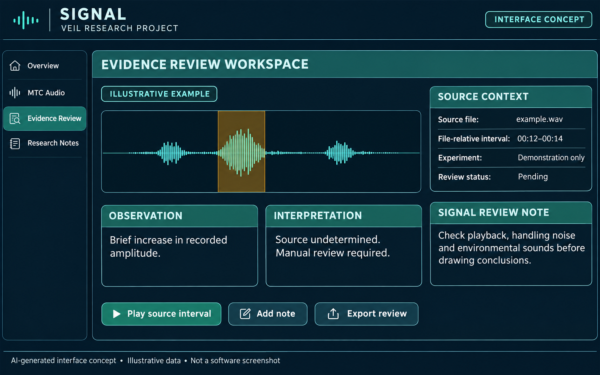
Interface concept illustrating how source recordings, review notes and uncertainty could be presented together, with observations separated from interpretation. AI-generated mockup with illustrative data; not a screenshot of operational software. Image: VEIL Research Project.
An investigator reviewing SIGNAL’s findings should be able to examine the original evidence and challenge the interpretation.
That traceability is particularly important when working with audio recordings, photographs, and environmental measurements.
Making Research More Accessible
There is another reason we’re developing SIGNAL.
Scientific curiosity shouldn’t be limited to people with expensive laboratories or advanced academic degrees.
Many independent investigators possess extraordinary curiosity and dedication but lack access to professional research equipment, technical resources, or formal training.
Artificial intelligence may help narrow some of those gaps.
Our philosophy at VEIL is simple:
AI helps the ordinary person do extraordinary things.
That doesn’t mean AI transforms speculation into scientific fact.
It means that accessible tools may help ordinary people organize better experiments, understand technical information, and approach difficult questions with greater discipline.
We’re especially interested in how equipment developers, independent investigators, and academic researchers might contribute different strengths to that effort.
VEIL is still an independent, early-stage initiative, operating without a dedicated physical research center.
Our ambitions are larger than our current resources, but we believe good research begins with sound questions and carefully documented observations, not expensive buildings.
What Happens Next?
SIGNAL’s development continues alongside VEIL’s experimental equipment projects.
Our priorities include improving local conversation and voice interaction, connecting research records, developing reliable instrument interfaces, and establishing reproducible methods for evaluating unusual observations.
We also hope to involve researchers who can critically evaluate our procedures and help identify weaknesses before those weaknesses influence conclusions.
Ultimately, the value of SIGNAL won’t be measured by how many anomalies it identifies.
It will be measured by how reliably it helps investigators document observations, identify uncertainty, challenge assumptions, and preserve evidence for independent examination.
Perhaps future experiments will reveal phenomena that existing explanations cannot adequately account for.
Perhaps better instrumentation will demonstrate that many seemingly extraordinary events arise from entirely ordinary causes.
Either outcome would represent progress.
Because the purpose of research isn’t to protect a particular belief.
It’s to discover what the evidence can actually support.
And if SIGNAL can help us do that, then we’ve already accomplished something worthwhile.
About the author: Andrew Underwood is the Founder and Lead Researcher of the VEIL Research Project, an independent initiative developing experimental instrumentation and AI-assisted research methods for investigating unexplained environmental phenomena.
Learn more at https://veilresearchproject.github.io/veil-research-project/
Enjoy Paranormal Globe?
Add us as a Preferred Source on Google to see more latest stories in Google Search.
About the Author: Guest Post