
Avebury: Where Landscape, Legend, and Experience Overlap

I have a visit to Avebury planned in the near future. Before going, I did what I tend to do with places like this. A bit of reading here and there, a few notes, nothing too organised. Just trying to get a feel for it in advance, though that only goes so far.
It did not take long to realise that Avebury refuses to settle into anything straightforward.
Some places come across clearly on paper. You understand their layout, their story, even something of their atmosphere. Avebury does not quite allow for that. The more you look into it, the more it seems to shift between things. Monument, village, landscape, gathering place. It sits across all of them without fully committing to any single one.
That may be where its reputation begins.
An Unusual Setting
Avebury is often compared with Stonehenge, though the similarity is mostly superficial. At Stonehenge, everything feels deliberate. The stones are shaped, positioned, and arranged so you can take them in as a whole.
At Avebury, it is different. You do not stand back and see it. You find yourself in the middle of it without quite noticing when that happened.
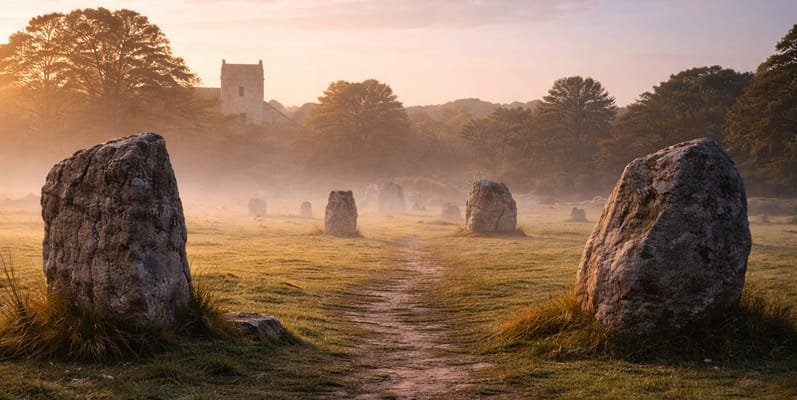
The stones themselves are uneven, weathered, and spread out across a wide area. Some stand upright, others lean, a few seem almost out of place. There is no obvious point where it all comes together.
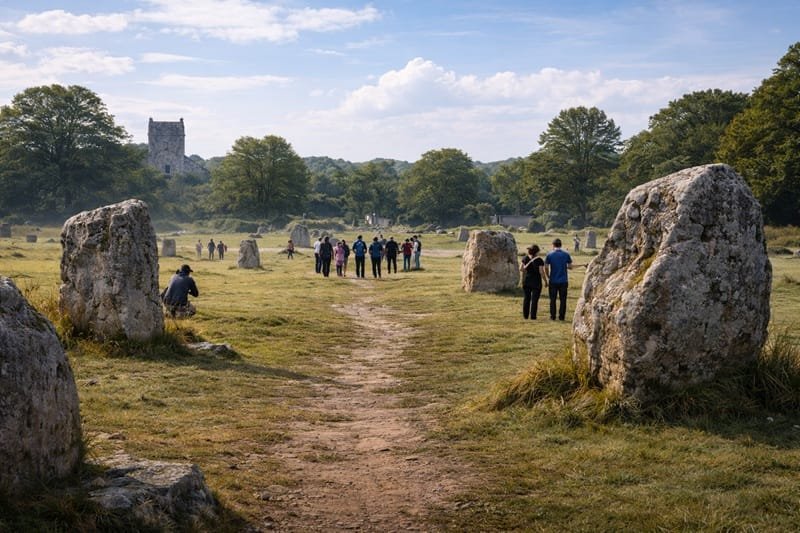
A road cuts through the site. Houses sit quietly among the stones. People pass through as part of their day. It is not separated off or presented in a controlled way. Life continues inside it.
A Landscape That Doesn’t Sit Still
The main circle is usually dated to around 2500 BC, but that only tells part of the story. Silbury Hill sits nearby, rising out of the ground in a way that feels oddly separate from everything else. West Kennet Long Barrow lies along the ridge, and the remains of old avenues hint at connections that are no longer immediately visible.
On paper, it reads as a coherent prehistoric complex. Standing within it, the impression is less tidy. It feels spread out, as though the pieces belong together but no longer explain themselves clearly.
You are not looking at a single monument. You are moving through something that was once part of a larger design, now only partly understood.
Reports That Don’t Quite Fit
What stands out with Avebury is not a single famous ghost story. There is no widely agreed figure or repeated apparition tied to one location.
Instead, there is a pattern of smaller things.
People describe small things rather than anything dramatic. A shift in the air that is hard to explain. A sense, briefly, that someone is there when no one is. It tends to pass quickly.
On their own, these moments do not amount to much. It is the way similar accounts keep turning up that makes them harder to ignore entirely.
Even those who would not usually entertain the idea sometimes comment on it, almost in passing.
Folklore and Belief
The stones themselves have drawn attention for centuries.
There are references, scattered and inconsistent, to attempts to damage or move the stones, and to the belief that doing so led to bad outcomes. Whether those stories were shaped later or have some older basis is not entirely clear, but they point to a long-standing reluctance to interfere with the site.
More recently, different ideas have settled over the landscape. Ley lines, earth energies, and the suggestion that something lingers in the ground itself. Not everyone takes this seriously, but it has become part of how Avebury is approached.
On certain days, you will find small groups among the stones, using the space in their own way rather than simply observing it.
When the Light Fades
From what I have gathered, the character of Avebury shifts again once the crowds thin out.
During the day, there is movement. Conversation. A sense that you are sharing the space. Later on, that falls away.
The openness is still there, but without people it feels slightly exposed rather than welcoming.
The stones do not change, of course. It is your sense of them that shifts.
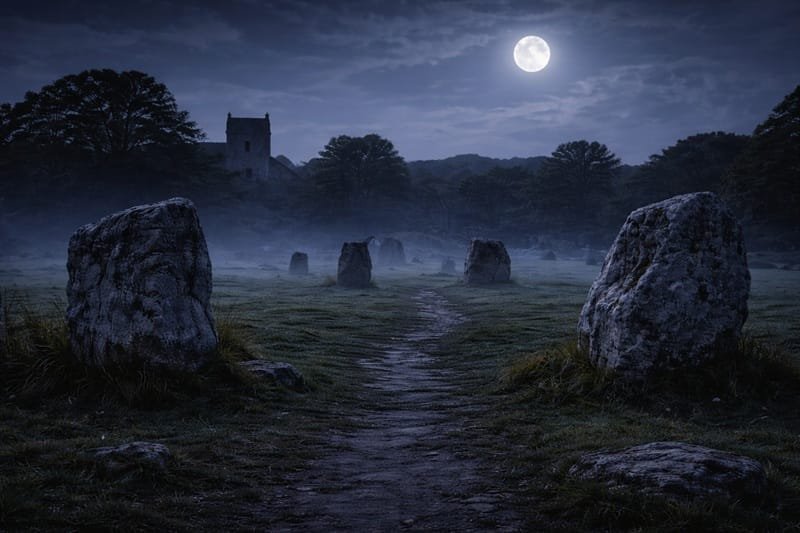
Sounds carry further. Shapes are less certain. Distances feel slightly altered.
After Dark Impressions
It is usually at these quieter times that people mention feeling unsettled. Nothing obvious. Just the same kind of impressions, but with less to distract from them.
Not sightings in any clear sense. More the feeling that something is just out of reach of explanation.
Whether that comes from the setting, expectation, or something else is left open.
A Place That Leaves Space
At this stage, before actually visiting, the impression is not of a “haunted site” in the traditional sense.
It is something quieter than that.
Avebury sits somewhere between things. Part history, part suggestion, part personal experience, depending on how you come to it. The accounts linked to it rarely lead anywhere definite, but they do not disappear either.
That may be the point. It leaves enough space for people to decide for themselves what, if anything, is going on.
I suspect the real answer, if there is one, comes from standing there rather than reading about it.
Enjoy Paranormal Globe?
Add us as a Preferred Source on Google to see more latest stories in Google Search.
About the Author: Richard Clements

[…] Avebury: Where Landscape, Legend, and Experience Overlap appeared first on Paranormal Globe […]