Inside the VEIL Panic Box: A New Approach to Recording Paranormal Experiences

By Andrew Underwood, founder of the VEIL Research Project / VEIL Labs
Someone hears a voice, sees movement or feels that something unusual has happened. They call an investigator. By the time anyone arrives, the moment has passed.
The person may remember the experience clearly, but investigators still face a difficult question: what was happening in the room immediately before, during and after it?
That question has stayed with me since my days as a paranormal investigator. It is now central to the VEIL Research Project, an early-stage research initiative I am developing in Girard, Pennsylvania, near Erie.
Our proposed first pilot is a portable monitoring system called the Panic Box. The name refers to a simple way for someone to mark an unusual experience. Pressing its button would mean “something happened that I want reviewed.” It would not mean that the system had detected anything paranormal.
The Panic Box is currently a proposed design. Engineering quotations and external funding are being pursued; there is no completed field-tested device or demonstrated paranormal detection capability to report. What we can explain is the question we want to investigate and the process we intend to test.
Keeping the moments around an experience
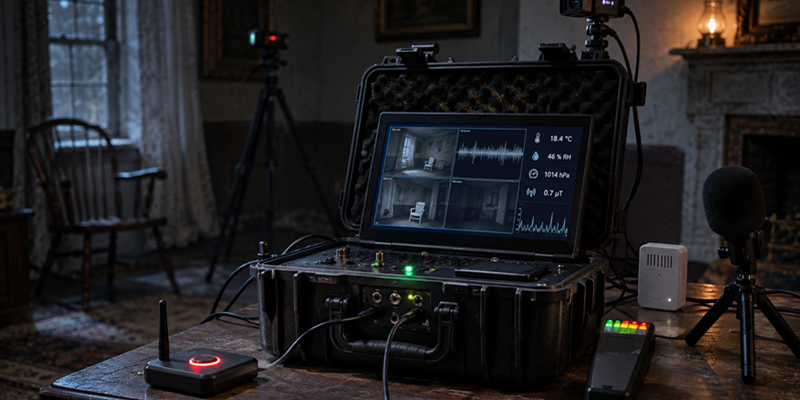
The proposed system would continuously record cameras, microphones and environmental sensors in an agreed monitoring area. A button on the case and a portable wireless button would let an occupant mark the approximate time of an experience.
That action would preserve available recordings from a defined period before and after the button press and queue an investigator alert. The exact recording windows, sensor package and communications arrangements remain engineering decisions.
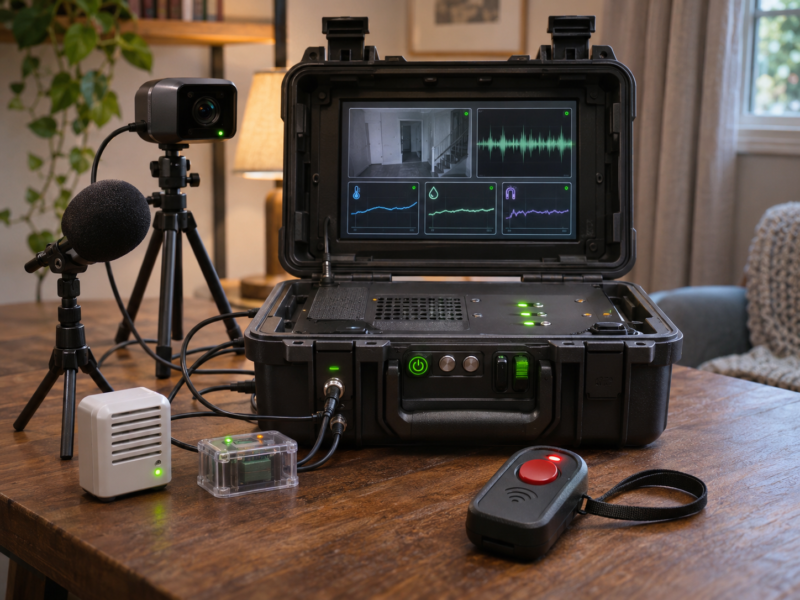
AI-generated concept illustration of the proposed Panic Box monitoring system, combining cameras, audio recording and environmental sensors. Image: Paranormal Globe.
Pre-event recording matters to the design because the button will usually be pressed after someone notices something. The button time and the person’s estimate of when the experience began would therefore be recorded separately.
Consider a hypothetical example: an occupant hears a knock and presses the button. Investigators could review the preceding audio, camera views and environmental readings alongside the occupant’s account. Perhaps another recording captures a door closing. Perhaps equipment cycles at the same time. Perhaps the source remains unclear. The purpose would be to preserve enough context to examine those possibilities.
Giving ordinary conditions equal attention
Before interpreting a change, we would need to understand how the monitored location behaves under ordinary conditions.
The proposed process would include baseline recording and a log of relevant activity: occupants entering or leaving, doors opening, appliances operating and other known changes. Sensor placement and equipment settings would also need documenting.
An environmental reading would be one observation to examine, not a verdict. A temperature change, for example, would prompt checks of conditions such as airflow, heating or cooling activity, and the instrument itself. A surprising sound would prompt review of available recordings and possible sources.
If we could not identify a cause, the result would remain unresolved. An unresolved observation would not, by itself, establish a paranormal explanation.
Separate a person’s account from the instruments
The occupant’s experience and the recorded data would be treated as related but separate evidence.
Where practical, we would ask the person to describe what happened before showing them the recordings. The account would include what they noticed, where they were and their best estimate of the timing. Investigators could then compare that account with the preserved material without rewriting it to match a sensor change.
We would also need to distinguish between an experience with a recorded change, an experience with no apparent recorded change, and a recorded change that nobody reported experiencing. Each outcome would help us assess what the system actually captures.
Analysis should flag questions
Baseline-based software analysis is part of the proposed approach. Its role would be to flag changes for human review, with any AI-assisted observations clearly identified as interpretations.
Original recordings would need to remain available alongside those interpretations. Investigators should be able to examine the underlying material and the reason a segment was flagged.
Missing recordings, clock discrepancies, wireless failures and instrument faults would also need documenting. A gap in the data would be a limitation of the recording, not a mysterious event. Likewise, a remote alert would tell an investigator that material was ready for review; it would not certify its cause.
First, test whether the recording system works
The first practical tests would concern engineering reliability. Can the button preserve the intended recording window? Can different streams be aligned accurately enough for review? What happens if communications fail? Are known sounds and ordinary environmental changes captured and correctly documented?
Those tests would need to include quiet periods and trials where nothing unusual happens. Such recordings could help reveal false alerts and establish the limits of the system.
Monitoring would also require informed permission, agreed camera and microphone coverage, and clear arrangements for access, retention and deletion. Occupants would need to understand what is being recorded and who could review it.
An invitation to improve the method
VEIL’s aim is to make reported experiences easier to examine with context, synchronized records and transparent limitations. That is the proposed contribution of the Panic Box.
I would welcome investigators’ perspectives on a practical question: when someone reports an unusual experience, what information do you most often wish had been recorded?
Better questions, reliable equipment and a willingness to document ordinary explanations would be useful outcomes in their own right. Whether a particular report ultimately has a clear explanation or remains unresolved, the quality of the record should come first.
About the author: Andrew Underwood is a former paranormal investigator based in Girard, Pennsylvania, and founder of the developing VEIL Research Project / VEIL Labs. This contribution describes his own proposed monitoring system. The Panic Box is in the design stage and has not yet been validated through field testing.
Enjoy Paranormal Globe?
Add us as a Preferred Source on Google to see more latest stories in Google Search.
About the Author: Guest Post