Playing the Ghost: When Victorians Became Their Own Monsters

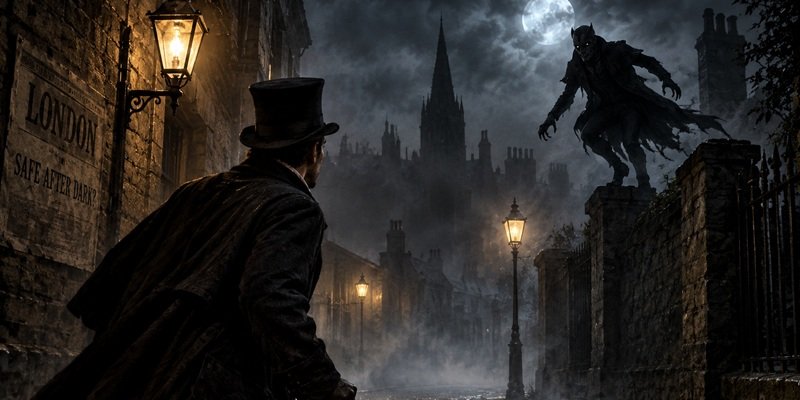
Spring-heeled Jack is usually presented as one of the great mysteries of Victorian England. Beginning in the late 1830s, witnesses described a strange figure who appeared suddenly in dark streets, frightened or attacked people, and escaped with apparently impossible leaps. Over time, Jack acquired claws, fiery breath and the ability to bound across walls and rooftops.
Whether one person ever stood behind the legend is doubtful. There may be another way of looking at him. Spring-heeled Jack appeared in a society already familiar with people who disguised themselves as ghosts and monsters before venturing out after dark.
Playing the Ghost
The practice was sometimes called “playing the ghost”. It could be no more than a foolish prank, but it was not always harmless. Ghost impersonators frightened travellers, pursued women and occasionally used their disguise to conceal robbery or assault.
A white sheet might be sufficient, although some costumes became far more elaborate. Masks, animal skins, horns and luminous materials all appeared in accounts from Britain and elsewhere during the nineteenth century.
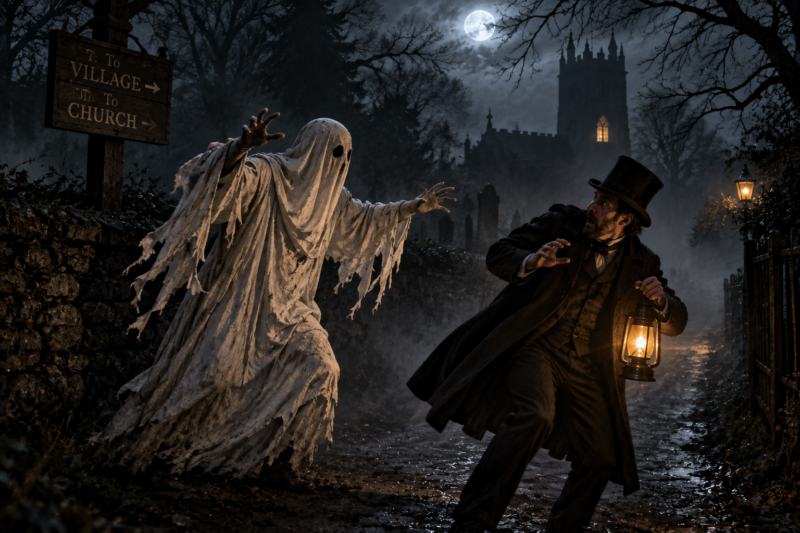
Ghost impersonators often frightened travellers and committed robbery and assault.
Darkness did much of the work. Before widespread electric lighting, even a familiar road could look very different at night. A pale figure glimpsed near a churchyard, gateway or hedgerow did not need to withstand careful examination. It needed only to be seen for a few seconds before disappearing.
The Hammersmith Ghost
One of the most disturbing examples occurred before the Victorian period, in Hammersmith during the winter of 1803–04. Stories were circulating about a ghost dressed in white that attacked people near the churchyard. The panic became so serious that armed men began patrolling the district.
On 3 January 1804, excise officer Francis Smith encountered Thomas Millwood, a bricklayer wearing the light-coloured clothing associated with his trade. Smith mistook him for the reported ghost and shot him dead. At the Old Bailey, Smith was convicted of murder, although his death sentence was later commuted.
The tragedy demonstrates how quickly a supposed haunting could become dangerous. Fear produced armed patrols, and those patrols went looking for something they already believed was there. Millwood had reportedly been mistaken for the ghost before, but on this occasion a combination of darkness, expectation and white clothing proved fatal.
The Ghost Returns
By the Victorian period, similar figures were appearing with some regularity. In 1872, reports of the “Peckham Ghost” caused alarm in south London. The figure was said to leap from the shadows and terrify people using the roads around Peckham. At least one account involved an attack upon a young woman. Contemporary newspapers naturally connected the mystery with Spring-heeled Jack, whose name was already part of popular culture.
That comparison is revealing. By then, Spring-heeled Jack was not simply a remembered assailant. He had become a ready-made identity. Any strangely dressed man who appeared suddenly, frightened a passer-by and escaped at speed could be placed inside the legend.
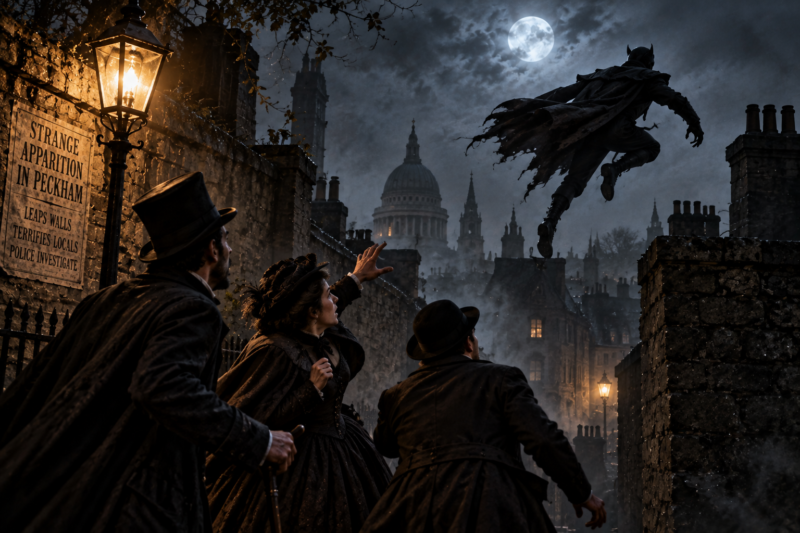
Spring-heeled Jack was said to suddenly appeared in dark streets, attacked people then leap away.
Reports from other parts of the country followed much the same pattern. At Newport Arch in Lincoln, a tall figure reportedly dressed in sheepskin was chased by a crowd in 1877. Around the same period, soldiers at Aldershot were said to have encountered a mysterious leaping intruder. Shots were supposedly fired, yet the figure escaped unharmed.
Whether these incidents involved practical jokers, local rumours or later embellishment is difficult to establish. What matters is that witnesses and newspapers possessed an existing language through which to describe them.
Ghosts in the Colonies
The phenomenon was not confined to Britain. In late nineteenth-century Australia, “ghost hoaxers” became sufficiently common to attract regular newspaper attention. Some used phosphorescent paint to make costumes glow in the dark. Others dressed as skeletons, knights or supernatural beings.
Behind the humour of these reports, however, are cases involving intimidation, indecent exposure and attacks on women.
A ghost costume offered its wearer more than a disguise. It created uncertainty. A victim might hesitate because they could not immediately decide whether the approaching figure was human. The impersonator also stepped outside the ordinary rules of behaviour. For a few minutes, he was no longer an identifiable neighbour, labourer or clerk. He had become a creature that could frighten, pursue and then vanish.
Creating a Monster
Newspapers helped these figures travel. A local prank might be reported as a haunting, repeated elsewhere and gradually decorated with further details. Once Spring-heeled Jack became famous, later incidents could be attached to him regardless of distance or time. Imitators may have borrowed from the legend, while the legend itself grew through their actions.
This does not explain every reported encounter, nor does it prove that all Victorian apparitions were men in costume. Contemporary reports mixed genuine impersonation with mistaken identity, rumour, journalistic exaggeration and folklore. Separating them after more than a century is rarely straightforward.
Nevertheless, the ghost hoaxers reveal something important about the making of supernatural legends. The Victorians did not merely tell stories about monsters. On occasion, they dressed as them, stepped into the darkness and allowed fear to complete the transformation.
Perhaps Spring-heeled Jack endured because there never needed to be only one Jack. Once the character had entered the public imagination, almost anyone with a disguise, a dark road and a taste for frightening strangers could bring him back.
Further Reading
Bell, Karl, The Legend of Spring-Heeled Jack: Victorian Urban Folklore and Popular Cultures (Boydell Press, 2012).
Dash, Mike, “Spring-heeled Jack: To Victorian Bugaboo from Suburban Ghost”, Fortean Studies, Volume 3 (1996).
Proceedings of the Old Bailey: Trial of Francis Smith, 11 January 1804.
Waldron, David and Sharn Waldron, “Playing the Ghost: Ghost Hoaxing and Supernaturalism in Late Nineteenth-Century Victoria, Australia”, Folklore, Volume 127, Issue 1 (2016), pp. 71–90.
Richard Clements is the writer and researcher behind The History Alchemist, exploring overlooked history, folklore and the stories that gather around historic places.
Enjoy Paranormal Globe?
Add us as a Preferred Source on Google to see more latest stories in Google Search.
About the Author: Richard Clements